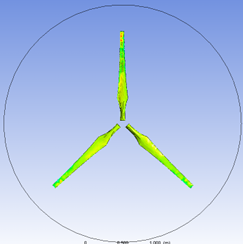
S823 Wind Turbine Blade Design and Analysis
2025, Dec 31
Project Overview: S823 Wind Turbine Blade Design and Analysis
This project presents an integrated analytical and computational study of a Horizontal Axis Wind Turbine (HAWT) blade designed around the S823 airfoil. The study transitions from manual aerodynamic optimization to high-fidelity numerical validation using QBlade and ANSYS.
System Configuration and Specifications
- Airfoil Profile: S823 airfoil, optimized for an angle of attack (\alpha_\mathrm{opt} = 7^\circ).
- Operational Parameters: Tip-Speed Ratio (\lambda = 7), rotational speed (400\,\mathrm{rpm}).
- Blade Geometry: Span discretized into ten radial stations for precise chord and twist distributions.
- Materials: Structural analysis assumes wooden blade construction with density (\rho = 553.6\,\mathrm{kg/m^3}).
Methodology and Technical Analysis
- Manual Optimization: Applied Betz–Schmitz optimum rotor theory to calculate ideal chord lengths and twist angles across the span.
- CFD Simulation: Used the k-ω SST turbulence model in ANSYS Fluent to capture pressure-velocity interactions and verify thrust.
- Fluid-Structure Interaction (FSI): Pressure distributions from CFD fed into a structural solver to evaluate stresses.
- Modal Analysis: Checked natural frequencies to ensure they are much higher than the operating frequency (f_\mathrm{op} = 6.67\,\mathrm{Hz}), eliminating resonance risk.
Key Performance Results
- Power Output: (P \approx 1025.76\,\mathrm{W}), Power Coefficient (C_p = 0.3657)
- Structural Safety: Maximum von Mises stress (\sigma_\mathrm{max} = 1.331\,\mathrm{MPa}), at the blade root.
- Deflection: Maximum tip deflection ( \delta_\mathrm{tip} = 0.436\,\mathrm{mm} ), showing high structural stiffness.
Key Mathematical Frameworks
1. Aerodynamic Inflow Angle
The inflow angle (\phi) at each radial station depends on the local tip-speed ratio (\lambda_r):
\[\phi = \frac{3}{2} \tan^{-1}\left(\frac{\lambda_r}{1}\right)\]2. Schmitz/Betz Chord Distribution
The chord length (c(r)) is calculated to optimize lift:
\[c(r) = \frac{B C_L}{16 \pi r} \left[ \sin\left(\frac{3}{1} \tan^{-1}\frac{\lambda_r}{1} \right) \right]^2\]3. Twist Distribution
The twist angle (\beta(r)) is:
\[\beta(r) = \phi - \alpha_\mathrm{opt}\]4. Power Coefficient
The aerodynamic efficiency of the rotor:
\[C_p = \frac{P}{0.5 \rho A V^3}\]Where (P) is power, (\rho) is air density, (A) is swept area, and (V) is wind speed.
5. Modal Stability
To avoid resonance, operating frequency (f_\mathrm{op}) must be much smaller than the first natural frequency (f_{n1}):
\[f_\mathrm{op} = \frac{400\,\mathrm{rpm}}{60} = 6.67\,\mathrm{Hz}, \quad f_{n1} \approx 76\,\mathrm{Hz} \gg 6.67\,\mathrm{Hz} \quad \text{(Safe)}\]📄 Full Project Documentation
You can access the full documentation here.