Phase Two Bridge Final Design
2025, Dec 31
Project Overview: Phase Two Bridge Final Design
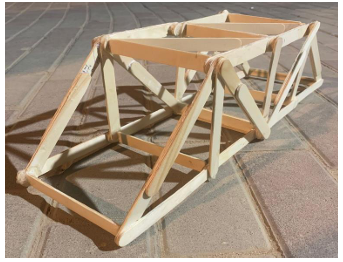
This project involved the design, fabrication, and structural analysis of a lightweight truss bridge prototype developed for the Mechanics of Materials course. The primary goal was to optimize the strength-to-weight ratio while ensuring ease of assembly using common materials.
System Configuration and Specifications
- Truss Type: Pratt truss configuration, efficient for tension-dominated lower members.
- Materials: Constructed using tongue depressors as structural members.
- Dimensions: Main span (0.40\,\mathrm{m}), height (0.12\,\mathrm{m}), depth (0.12\,\mathrm{m}).
- Physical Weight: (0.220\,\mathrm{kg}).
Technical Methodology and Analysis
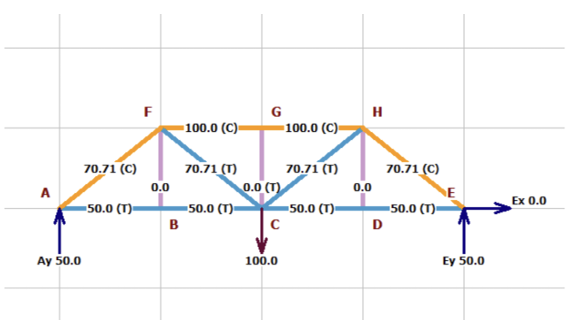
- Member Force Analysis: Members were classified under tension (T) or compression (C).
- Geometric Stability: Tongue depressors arranged into vertical and diagonal units to maximize structural integrity.
- Stress Distribution: Internal forces under a simulated 100 kg load ranged from 50.0 to 100.0 units.
- Safety Margin: Experimental results suggest the bridge can support additional weight beyond the test limits.
Key Performance Results
- Load Capacity: Successfully supported a maximum load of 58 kg without failure.
- Efficiency Score: Calculated as 263.63.
- Predictive Capacity: Estimated additional support of up to +40 kg.
Key Mathematical Frameworks
1. Bridge Performance Metric
The efficiency of the bridge was quantified by:
\[\text{Score} = \frac{\text{Load (without failure)}}{\text{Weight of the bridge}}\]2. Experimental Calculation
\[\text{Score} = \frac{58\,\mathrm{kg}}{0.220\,\mathrm{kg}} \approx 263.63\]3. Member Force Analysis
Internal forces in the Pratt truss:
- Compression Members: (F_{\text{top_chord}} = 100.0\,\mathrm{units} \,(\mathrm{C}))
- Tension Members: (F_{\text{bottom_chord}} = 50.0\,\mathrm{units} \,(\mathrm{T}))
4. Reaction Forces
For a centrally applied load of 100 units:
\[\sum F_y = 0 \implies A_y + E_y = 100.0, \quad A_y = 50.0, \, E_y = 50.0\]📄 Full Project Documentation
You can access the full documentation here.